
It will be the first visit by a top US official after the Joe Biden administration took charge.

The exercise is taking place at a time India and China are locked in a nearly six-month-long bitter border standoff in eastern Ladakh that has significantly strained their ties.

His visit to India followed a few cancelled plans since he took office in July 2019 due to the coronavirus pandemic crisis, with the two leaders holding several virtual talks and eventually meeting in person on the sidelines of the COP26 climate summit in Glasgow last November.
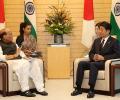
'Singh apprised the Japanese leaders about Islamabad's 'evil design' on Kashmir at a time when Pakistan has decided to internationalise the issue.'

'...it should not delude itself into thinking that India's security or its great-power ambitions will be advanced by those partnerships.'
'Instead, what India should focus on is on riding out the next three-and-a-half years of Trump's presidency with minimal damage to itself.'

Meanwhile, Prime Minister Narendra Modi arrived in Apulia to attend the Outreach session of the G7 Summit and hold bilateral talks on a wide range of issues with world leaders on Friday.

India and Japan on Thursday agreed to enhance military exercises and defence cooperation as the two countries emphasised that the bilateral special strategic and global partnership plays a crucial role in ensuring a free, open and rules-based Indo-Pacific, amidst China's aggressive behaviour in the region.

Modi said this 'special invitation' from President Joseph Biden and First Lady Jill Biden for a state visit is a reflection of the vigour and vitality of the partnership between the democracies.
A leading expert predicts that the incoming Trump administration will likely continue its pro-India policies, including the Indo-Pacific strategy and Quad, but highlights potential challenges such as trade disagreements, immigration issues, and a possible quid pro quo for technology sharing. The expert also notes that the Trump 2.0 administration may prioritize great power politics over strategic altruism, potentially impacting human rights and religious freedom concerns.
The statement of Commander of US Indo-Pacific Command Admiral John Aquilino on Wednesday came ahead of the 15th round of high-level military talks between India and China on March 11.
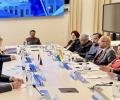
India has secured international support in its fight against terrorism, with Russia, Japan, and the United Arab Emirates expressing solidarity and a commitment to working together to combat the threat. This follows a recent terrorist attack in Pahalgam, India, which claimed 26 lives. Multi-party parliamentary delegations from India briefed the leaderships of these countries on Operation Sindoor, India's response to the attack, and discussed ways to enhance cooperation in counter-terrorism and combating radicalism. These developments highlight the growing global consensus against terrorism and the importance of international collaboration to address this shared challenge.
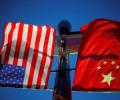
China has toned down its rhetoric on fighting a trade or any other type of war with the US, saying that no such wars should be fought because they cannot be won. Foreign Ministry spokesman Lin Jian responded to US Secretary of Defence Pete Hegseth's remarks that his country doesn't seek a war with China, but will rebuild the military and prepare for war. However, on Tuesday, Lin had said that China is ready to fight till the end if the US wants a trade war or any other type of war. Hegseth said on Wednesday that the US is not actively seeking conflict with China, but is rebuilding its military and establishing deterrence.

United States President Joe Biden is not travelling to India next month to grace the Republic Day celebrations as the Chief Guest, and New Delhi is looking at holding the next Quad summit later next year instead of its earlier plan to host it in January, people familiar with the matter said on Tuesday.
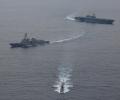
China said that military cooperation should be "conducive" to regional peace and stability.
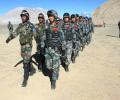
Esper also highlighted the 'increased' military cooperation with India and called it as 'one of the most important defence relationships of the 21th century'.

'The crisis has strengthened America's resolve to work towards building its relationship with India as a bulwark against Chinese aggression'

He said that Canada recognises the impact that some of these measures may have and at the same time it's another reason why he placed such emphasis on the investigation that's taking place that they are able to move beyond credible intelligence to evidence, strong evidence of exactly what happened.
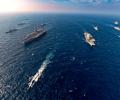
China's behaviour in the post-pandemic geopolitical landscape which may determine the Quad's future trajectory, notes former foreign secretary Shyam Saran.
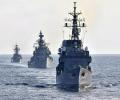
The Indian Navy is also ramping up its operational cooperation with various friendly naval forces like the United States Navy and Japan Maritime Self Defense Force in view of the fast evolving regional security landscape, they said.
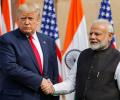
The China threat continues to resonate in the strategic partnership between India and the USA, points out Rup Narayan Das.
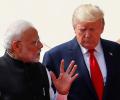
'While criticising India's high tariffs, Mr Trump stated he would impose reciprocal taxes on Indian products if re-elected.' 'However, since India's tariffs follow WTO rules, Mr Trump's actions would violate these rules,' Ajay Srivastava points out.

'The US and India continue to use their deepening relationship to build new partnerships within and beyond the Indo-Pacific.'
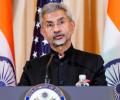
External Affairs Minister S Jaishankar on Friday spoke to newly appointed United States Secretary of State Antony Blinken during which they expressed commitment to consolidate and expand the India-US strategic partnership and reiterated commitment to peace and security in the Indo-Pacific region.

US Secretary of State Antony Blinken said that the United States is calling on all nations not to have major weapons transactions with Russia. He made these marks after the conclusion of the 2+2 Ministerial Dialogue between the defence and foreign ministers of India and the United States.
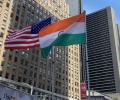
Richard Verma, the highest-ranking Indian-American official in the State Department, has expressed optimism about the future of US-India ties and emphasized the need to base the relationship on shared values rather than mere transactional dealings. Verma, who previously served as America's Ambassador to India, stressed the importance of the Quad in defending the international order, highlighting its shared commitment to a free and open Indo-Pacific.

'When the issue of terrorism came up, the Vice President suo moto referred Pakistan's role in that regard (of terrorism),' Foreign Secretary Harsh Vardhan Shringla told reporters when asked if the issue of Pakistan's role in terrorism came up during her meeting with Modi.

In a veiled reference to China's aggressive military behaviour, Defence Minister Rajnath Singh on Thursday said exercising self-restraint in the conduct of activities and avoiding actions that may further complicate situation will go a long way in bringing sustained regional peace.
The second phase of the mega exercise is scheduled to be held from November 17 to 20 in the Arabian sea.

The opinion piece added that the party combines the most striking principles of three major political entities in the world -- the Likud Party of Israel, the Communist Party of China and the Muslim Brotherhood of Egypt.

Prime Minister Narendra Modi's visit to the United States this month will set new benchmarks for bilateral ties and some 'really big, historic and exciting' announcements are likely to be made on defence cooperation and boosting India's indigenous military industrial base, the Pentagon has said.
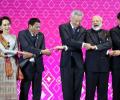
The prime minister also welcomed convergence of views between India and ASEAN for cooperation in the Indo-Pacific region.

The Indian and Chinese troops have been locked in a tense border standoff in eastern Ladakh since May 5, 2020, when a violent clash between the two sides erupted in the Pangong lake area.

United States Defence Secretary Lloyd J Austin arrived in India on Friday on a three-day visit, aimed at further boosting bilateral defence and security ties in the wake of China's growing military assertiveness in the region including the Indo-Pacific.

Prime Minister Narendra Modi will pay a three-day visit to the United States beginning September 21 to attend the annual Quad Summit and address the 'Summit of the Future' at the United Nations General Assembly.

Vice Chief of the Army Staff Lt Gen S K Saini will embark on a four-day visit to the US beginning Saturday to explore ways to further deepen military cooperation between the two countries. The visit comes ahead of the third edition of the two-plus-two dialogue between India and the US which is slated to be held in India later this month.

Prime Minister Narendra Modi and French President Emmanuel Macron held extensive discussions on a range of bilateral and pressing global issues, including the raging conflict in Ukraine, the situation in the Indo-Pacific and terrorism, as the two top leaders agreed on a blueprint to work together in making the India-France strategic partnership a force for global good.
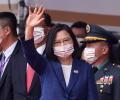
An independent Taiwan under President Tsai Ing-wen's Democratic Progressive Party is anathema to China, observes Rup Narayan Das.

United States Secretary of State Antony Blinken during his maiden trip to India next week would meet Prime Minister Narendra Modi and External Affairs Minister S Jaishankar to discuss wide range of bilateral, regional and global issues, his spokesperson said on Friday.

'If Washington has to balance Chinese power, she will have to turn to the third biggest power in the world which is India.' 'The United States and India will have to work together in order to keep Chinese ambitions in check.'

China, which has territorial disputes with many countries in the strategic Indo-Pacific region, has been opposing the Quad alliance since its formation.
